
Last week I did a brief Introduction on this hormone and what it’s purpose is in our body as well as the physiological pathway it runs.
This week let’s look at cortisol itself and how it works with metabolism. Cortisol is a hormone within the suite of corticosteroids produced in our adrenal cortex. See last week’s post to look at the top of our kidneys where their is a “gnome hat” also known as the adrenal glands.
Corticosteroids are divided into two groups where the group that contains cortisol (gluccocorticoids) controls carbohydrate, protein and fat (nutrient macromolecule) metabolism as well as a number of other mechanisms that lead to our blood pressure regulation, cardiovascular function and many other processes including efficiency of our eye sight. Gluccocorticoids work to regulate blood glucose levels (see the prefixes there – science is not out to fool anyone with some of these processes).
Here is a drawing of a molecule of cortisol simply so that we can put this topic in a visually contextual realm.
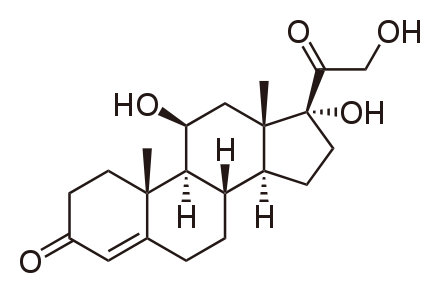 image via WikiMedia Commons
Cortisol is a catabolic molecule meaning it breaks things down – essentially other molecules (except liver cells). For our metabolism this means carbohydrates, proteins, and fats (those macromolecules we consume in everything) as well as those that make up our bodies like muscles and fat (proteins and fat cells where fat is the result of consuming fat or consuming too many carbohydrates that become converted to fat cells). Cortisol becomes a mover and shaker of sorts with what is broken down, to lead to what is built up and the rates that these numerous processes occur. Cortisol also deals with inflammation – think of cortizone and how that is used in context to reduce inflammation in injuries or break down things that should not be built up in our bodies if we are well.
And to return to glucose regulation as a glucocorticoroid, glucose is the simplest sugar form there is and the easiest to form when breaking down molecules. It will be the macromolecule most present in catabolic activities.
Our bodies work for a healthy balance. We have a term of homeostasis that is a fail-safe to make sure our essential organs keep moving and are inputting, outputting, and working in-between for our heart, lungs, and kidneys. The rest of our bodies are smart too and all the many components that work with involuntary and voluntary processes try to work for a balance as well.
The reason that cortisol may become a concern for people is when their bodies become stressed either from perceived stressed from stimuli and/or from internal stress when systems of the body become imbalanced. Either way when we begin to produce too much cortisol processes begin to go haywire and it is unidirectional to lose weight or gain weight through feedback loops or inhibition. Too much cortisol acts on the protein that delivers messages to our hypothalamus to send hormones to our adrenal to ask for more cortisol when “needed” – when we have too much in our body it tries to shut down the telephone game that keeps its production going… this is some stress on its own that underlies whatever stress we are trying to react to.
Next week I will write about what happens when our bodies produce too much cortisol and how this imbalance affects weight and other stress-induced attributes as well how companies and marketers prey on consumers looking to get their bodies back to balance.
I am not a doctor but I taught Human Biology Labs to undergrads while working on a PhD in Biology. My emphasis was ecology and environmental issues but I loved teaching this class to make better informed people in our communities. Hope I can share some of that with you.
Thank you. This is very helpful. I have been having a hard time understanding the mechanics of it. XO